

Best Japanese Bath Salts & Onsen Goods to Buy in 2026 (BARTH, Bub & More)
Updated July 2026 · 11 min read
Japan Shop Helper Editorial
Tokyo-based · prices & fees verified on real orders
Of everything you can carry home from Japan, almost nothing packs as much of the country into as little suitcase space as its bath products. A single drugstore aisle holds carbonated tablets that fizz a plain bathtub into something close to a hot spring, salt blends named after famous onsen towns, and a supporting cast of tenugui towels, scrub cloths, and foam nets that Japanese households treat as everyday essentials. This guide sorts the cult favorites from the filler — what BARTH and Bub actually do differently, which bath salts are worth the shelf space, and which items make the cheapest, lightest, most giftable souvenirs you can buy in bulk.
Heads Up
Why Japanese Bath Culture Travels So Well
Japan treats the bath as a ritual, not a rinse. The nightly soak — a proper shoulder-deep sit in hot water after washing outside the tub — is so embedded in daily life that an entire product category exists to upgrade it: nyuyokuzai, or bath additives. Supermarkets devote whole shelves to them, and the best-known lines have been refined over decades for one specific job — making ordinary tap water feel more like the mineral-rich water of an onsen.
For travelers, this category has three qualities that almost nothing else in a Japanese drugstore combines. First, the products are genuinely hard to find abroad at Japanese prices — export markups on carbonated tablets routinely double or triple the cost. Second, they are light, flat, and nearly indestructible: a month of baths weighs less than a paperback. Third, they need no explanation as gifts. Hand someone a packet printed with a mountain hot-spring scene and they understand it instantly, no shared language required.
Carbonated Bath Tablets, Explained: The Cult of the Fizz
The most distinctive Japanese bath product is the carbonated tablet — a dense puck that dissolves in the tub, releasing carbon dioxide into the water. The idea borrows from Japan’s natural carbonated springs, whose warm, fizzy water has been prized for generations. In a home bath, the appeal is simple: the water feels softer, warmth seems to sink in deeper, and the post-bath drowsy glow that Japanese bathers prize arrives faster than with plain hot water.
Two names dominate the category, and they sit at opposite ends of it. Bub is the approachable, colorful everyday brand found in every supermarket; BARTH is the stripped-back premium option sold in minimalist packaging at a noticeably higher price per bath. Understanding the difference is the key buying decision in this whole guide, so each gets its own section below.
Pro Tip
BARTH: The Minimalist Premium Tablet
BARTH built its reputation on restraint. The tablets are fragrance-free and colorant-free — no lavender clouds, no neon-green water — and formulated as neutral-pH bicarbonate tablets designed to dissolve slowly and keep the water gently carbonated through a long soak. The standard ritual is three tablets per bath, which is why the small boxes are counted in multiples of three. It has become the bath product that Japanese lifestyle media and gift guides reach for first, and the one overseas visitors most often buy again once the first box runs out.

The honest caveat: BARTH is priced like a small luxury, working out to several hundred yen per bath. Treat it as the occasion product — the end of a brutal week, sore legs after a hiking day — and keep a cheaper everyday option alongside it. Which brings us to Bub.
Bub: The Everyday Classic Every Japanese Household Knows
Bub, made by Kao, is the opposite proposition: one tablet per bath, cheerful scents, and a price that makes a nightly fizzy soak completely unremarkable. It has been a fixture of Japanese bathrooms for decades, and the assorted packs — a mix of scents like yuzu, forest, and lavender in one box — are the smart travel buy because you sample the range without committing to any single fragrance.

The BARTH-versus-Bub question resolves cleanly once you frame it as occasion versus habit. Bub is the daily driver; BARTH is the weekend indulgence. Most seasoned buyers simply get both — combined they still weigh less than a single bottle of duty-free whisky.
Onsen in an Envelope: Hot-Spring Bath Salt Blends
The other half of the bath-additive aisle skips the fizz and goes straight for atmosphere: powder and salt blends themed after Japan’s famous hot-spring regions. Each packet turns the water a soft mineral hue — milky white, sulfur green, iron amber — with a scent composed to evoke the town it’s named for. They don’t literally bottle onsen water, but as a nightly tour of Japan’s bathing geography, they are ridiculously good value.

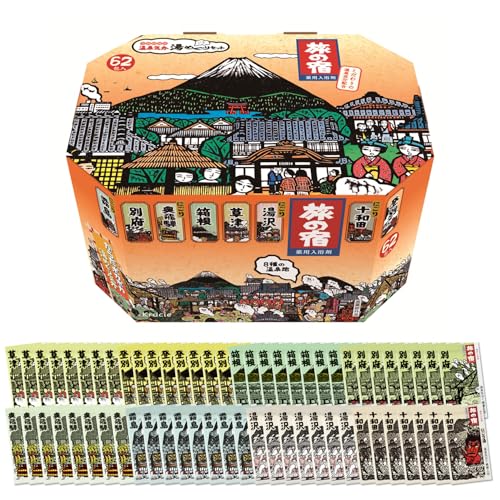
A practical note on choosing between tablets and salts: tablets are about the physical feel of the water, salts are about color, scent, and mood. If your recipient has a bathtub and an imagination, salts land harder as gifts; if they take baths seriously as recovery, tablets win.
The Supporting Cast: Tenugui, Akasuri, and the Foam Net
The additives get the attention, but the textiles around the Japanese bath are just as exportable. Three are worth suitcase space. The tenugui — a thin, flat-woven cotton cloth — is the multitool of Japanese bathing: it washes, dries almost instantly, folds to nothing, and doubles as gift wrap, a headband at the sento, or a wall hanging when the pattern is good enough.

The akasuri towel is the opposite of gentle: a long, deliberately textured scrubbing cloth used for full-body exfoliation, the home version of the vigorous scrub-downs offered at bathhouses. Used once or twice a week on soaked skin, it removes what loofahs merely tickle. And the humble foam net — awadate netto — is the secret behind the dense, whipped-cream lather Japanese body soap and facial cleansers are famous for; a few seconds of agitation turns a pea of cleanser into a bowl of foam.

Round out the kit with a few sub-¥1,000 practicals: a waterproof pouch to carry toiletries into a shared bathhouse, a pack of disposable shower caps, and a pair of ryokan-style indoor sandals if you want the full inn-at-home effect. If you’re planning actual onsen visits on the trip itself, our Japan onsen packing list covers exactly what to bring through the bathhouse door.
The Onsen-at-Home Ritual, Done Properly
The products only deliver if you borrow the method along with them. The Japanese bath sequence is wash first, soak second: cleanse completely before entering the tub, so the bathwater stays clean and the soak is purely for warmth and recovery. Fill the tub to shoulder depth at a moderate 38–40°C rather than the scalding temperatures Western hotel baths encourage — warm-and-long beats hot-and-short for relaxation, and it’s what carbonated tablets are formulated around.
Aftercare is the step most people skip. Hot soaking dehydrates skin surprisingly fast, which is why Japanese bathrooms keep a pump bottle of body milk within arm’s reach of the tub — Hada Labo’s Gokujyun body milk is the drugstore standard for exactly this moment. Drink water, moisturize while skin is still damp, and go to bed within the hour: the body-temperature drop after a warm bath is one of the better-known natural sleep cues. For what to layer on your face afterward, see our Japanese skincare routine guide.
Souvenir Math: Why Bath Goods Beat Almost Everything Else
Run the numbers against other souvenir categories and bath goods win on nearly every axis. Snacks expire and crush; ceramics weigh kilos and break; character goods are hit-or-miss with adults. A box of Bub or Tabino Yado costs under ¥1,000, weighs a few hundred grams, survives any baggage handler, clears customs without a second glance, and works for recipients of any age or gender who own a bathtub. Individually wrapped tablets and packets can even be split across several small gift bags — one ¥800 box becomes gifts for an entire office.
The tiering strategy that experienced shoppers use: sub-¥1,000 packets and tenugui for casual gifts in bulk, the ¥2,000–¥3,000 curated salt set for people who matter, and BARTH for the one friend who will actually appreciate the difference. For how bath goods stack up against the rest of the field, our best souvenirs from Japan guide ranks the full landscape.
Where to Buy and How to Pack Them
In person, the best hunting grounds are big drugstore chains and Don Quijote for the mainstream lines, and museum shops or craft stores for premium tenugui patterns. But the quietly superior move for bulky multi-box hauls is Amazon Japan delivered to your hotel: assorted packs are often cheaper online than on tourist-district shelves, and you skip carrying a week of shopping across three cities. Order early in the trip and the boxes are waiting at the front desk.
Packing is blissfully easy. Everything here is solid, so it all goes in checked or carry-on luggage without liquid restrictions — the one exception being any liquid body milk over 100ml, which must be checked. Keep tablets in their sealed wrappers (humidity is the enemy of anything effervescent), tuck packets flat between clothing layers, and let tenugui do double duty wrapping anything fragile.
Pro Tip
Quick Comparison: The Core Bath Buys
| Product | Type | Price Range | Best For |
|---|---|---|---|
| BARTH (9 tablets) | Carbonated tablet, unscented | ¥1,500–¥2,500 | Premium recovery soaks; fragrance-averse gifts |
| Bub assorted pack | Carbonated tablet, scented | ¥500–¥1,000 | Everyday baths; bulk giftable value |
| Tabino Yado salts | Hot-spring-style powder packets | ¥800–¥1,500 | Onsen atmosphere; most evocative cheap souvenir |
| Bath salts gift set | Curated salt assortment | ¥2,000–¥3,000 | Presentable mid-tier gifts |
| Tenugui towel | Flat-woven cotton cloth | ¥500–¥1,500 | Fast-dry towel, wrap, and décor in one |
| Akasuri scrub towel | Exfoliating body cloth | ¥300–¥800 | Bathhouse-grade exfoliation at home |
Onsen-at-Home Shopping Checklist
Frequently Asked Questions
Can I bring Japanese bath salts and tablets through airport security?
Yes. Tablets and powder-packet bath salts are solids, so they face no liquid restrictions in carry-on or checked luggage. They are ordinary consumer cosmetics and clear customs in most countries without issue — keep them in their original sealed packaging, which also protects effervescent tablets from humidity.
What is actually the difference between BARTH and Bub?
Both are carbonated tablets, but they target different habits. Bub is one scented, colored tablet per bath at an everyday price; BARTH is a fragrance-free, colorant-free neutral bicarbonate formula used three tablets at a time and priced as a premium product. Think daily driver versus special-occasion soak — many buyers simply keep both.
Do carbonated bath tablets work in Western bathtubs?
They do — any tub that holds enough water for a shoulder-deep (or at least torso-deep) soak works. The main adjustment is temperature and time: aim for a warm 38–40°C bath and stay in for 10–20 minutes rather than a brief scalding dip. In an oversized tub, scale up the dose per the package guidance.
Are these good souvenirs for people who don’t know Japan well?
They’re among the best precisely because no context is needed — a bath is universal, and the onsen-town artwork on packets like Tabino Yado explains itself. They suit any adult with a bathtub, cost little, weigh almost nothing, and don’t expire quickly. The main person to skip is a shower-only household.
Is it cheaper to buy these in a drugstore or on Amazon Japan?
For single boxes, drugstore and online prices are usually close, and tourist-district stores sometimes run tax-free promotions. For bulk hauls — five boxes of Bub, a stack of gift sets — Amazon Japan delivered to your hotel is typically as cheap or cheaper and saves you hauling the boxes between cities. Either way, prices in Japan beat export resellers by a wide margin.
Disclosure
This article contains affiliate links. We may earn a commission when you buy through them, at no extra cost to you. Every pick is an honest recommendation.
Planning to buy from Japan?