

Best Japanese Collagen Drink 2026: Shiseido vs Meiji vs Orihiro — Fully Ranked
Updated June 2026 · 14 min read
Japan Shop Helper Editorial
Tokyo-based · prices & fees verified on real orders
Collagen drinks are easy to write off as a scam — tiny overpriced bottles, vague claims, the whole thing can feel like a wellness grift. But track skin carefully — photos, same lighting, same time of day — and some users report a noticeable difference after about twelve weeks of daily Shiseido The Collagen. The category deserves a closer look than its reputation suggests.
The evidence on oral collagen peptides is promising but not conclusive. What’s clear: Japan has been making these products since the 1990s, annual sales exceed ¥100 billion, and the formulations here are genuinely more sophisticated than what’s sold overseas at four times the price. Below, 10 ranked products with real doses, Japan prices, and the overseas markup so you know what you’re saving.
Why Japan Makes the Best Collagen Drinks on the Market
Japan’s “beauty from within” philosophy—called innā byūtī(インナービューティー)—treats skincare as something that starts in the gut, not just on the surface. The concept gained mainstream traction in the early 1990s, when brands like Shiseido and Fancl began marketing oral supplements specifically for skin elasticity.
Today, collagen drinks are as normal as vitamin C tablets in the West. You’ll find them in vending machines at train stations, next to the energy shots at every konbini, and stacked in pyramids at Matsumoto Kiyoshi and Sundrug. The format is also distinctly Japanese: most are pre-mixed, single-serve 50 ml shots meant to be downed in one go—nothing like the big tubs of Western collagen powder you scoop into smoothies.
Japanese manufacturers typically use hydrolyzed collagen peptides with a molecular weight between 2,000 and 5,000 Daltons. Smaller peptides are believed to absorb more efficiently than full-chain collagen molecules, which is why many Japanese formulations emphasize “low-molecular-weight” (低分子) on the label. A 2019 review published in the Journal of Cosmetic Dermatologyfound that oral hydrolyzed collagen peptides at doses of 2,500–10,000 mg per day were associated with measurable improvements in skin hydration over 8–12 weeks. That said, individual results vary, and the collagen drink industry in Japan is backed more by consumer loyalty than by large-scale Western-style clinical trials.
If you’re interested in other Japanese health and beauty staples that tourists consistently stock up on, check out our guide to buying Japanese sunscreen — another product category where Japan punches well above its weight.
The Science in 90 Seconds
Collagen is the most abundant protein in your body, making up about 75% of your skin’s dry weight. Natural collagen production declines roughly 1% per year after age 25. Hydrolyzed collagen peptides (the form in most Japanese drinks) are broken down into fragments small enough to pass through the intestinal wall and reach the bloodstream.
Peer-reviewed meta-analyses—including one in the International Journal of Dermatology(2021)—suggest that daily supplementation between 2,500 and 10,000 mg may improve skin elasticity and hydration after 6–12 weeks. However, these studies have relatively small sample sizes, and the beauty industry’s own-funded research can carry bias. The honest takeaway: the evidence is promising but not conclusive. Most Japanese consumers treat collagen drinks as a long-term daily habit rather than a quick fix.
One thing that isn’t controversial: absorption. Hydrolyzed peptides at 2,000–5,000 Da absorb measurably better than intact collagen or gelatin. This is the reason Japanese manufacturers invest heavily in low-molecular-weight processing, and it’s the main differentiator from cheaper collagen supplements sold abroad.
The 10 Best Japanese Collagen Drinks, Ranked
Rankings consider four factors: collagen dose per serving, taste and drinkability, price per serving in Japan, and availability (how many stores carry it). All prices are what you’d pay at a typical Matsumoto Kiyoshi, Sundrug, or konbini in 2026.
| Rank | Product | Collagen / Serving | Format | Price (Japan) | Best For |
|---|---|---|---|---|---|
| 1 | Shiseido The Collagen Drink | 10,000 mg | 50 ml shot | ¥240 | Best all-around pick |
| 2 | Meiji Amino Collagen Premium | 5,000 mg | Powder sachet | ¥3,200 (28 days) | Best powder for daily habit |
| 3 | Orihiro Night Diet Collagen | 6,000 mg | Granule sachet | ¥1,480 (20 days) | Sleep + collagen combo |
| 4 | Fancl Mild Collagen Drink | 5,000 mg | 50 ml shot | ¥280 | Sensitive stomachs |
| 5 | DHC Collagen Beauty 7000 | 7,000 mg | 50 ml shot | ¥260 | High dose on a budget |
| 6 | Morinaga Amino Collagen Drink | 3,000 mg | 100 ml bottle | ¥180 | Casual konbini sipper |
| 7 | Naris Up Collagen Drink | 3,000 mg | 50 ml shot | ¥160 | Cheapest option |
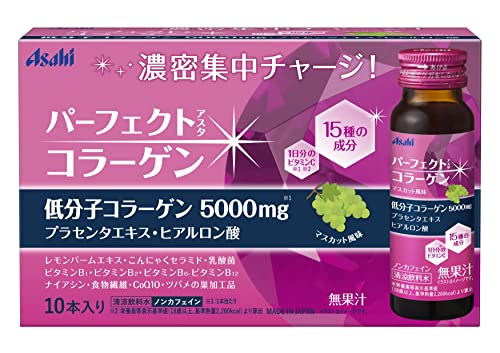
| 8 | Asahi Perfect Asta Collagen | 5,500 mg | Powder (can) | ¥2,800 (28 days) | Fermented supplement fans |
| 9 | ORBIS Collagen Powder | 5,000 mg | Stick sachet | ¥2,160 (30 days) | Minimalist buildable dose |
| 10 | DECENCIA Ayanasu Inner Beauty | 8,000 mg | 50 ml shot | ¥540 | Luxury department-store tier |
Individual Product Breakdowns
1. Shiseido The Collagen Drink — Best All-Around
At 10,000 mg of low-molecular-weight collagen peptides in a 50 ml bottle, Shiseido’s flagship collagen drink packs the highest dose on this list into the smallest container. The taste leans lightly fruity—a peach-mango hybrid that most people describe as “not great, not terrible.” You’ll find it at virtually every Matsumoto Kiyoshi, Sundrug, and Welcia, plus most 7-Elevens and Lawsons.
The kicker: this same bottle retails for $8–12 on Amazon US and Asian grocery import sites. At ¥240 (about $1.60) in Japan, you’re paying roughly one-fifth the overseas price. If you buy a 10-pack box at a drugstore, the per-unit price drops to around ¥220. This is the one worth buying consistently. A ten-pack from Matsumoto Kiyoshi, ¥2,200, fits in a corner of any bag. If you try nothing else on this list, try this.

2. Meiji Amino Collagen Premium — Best Powder
Meiji’s powder is Japan’s most popular collagen supplement by unit sales. The “Premium” version adds CoQ10, ceramides, and hyaluronic acid on top of 5,000 mg of fish-derived collagen peptides. You dissolve one scoop (7 g) into coffee, tea, or miso soup. The powder dissolves in about 15 seconds in hot liquid, 30 seconds in cold.
A 196 g can lasts 28 days and runs about ¥3,200 at most drugstores. That works out to ¥114 per day—cheaper than any ready-to-drink shot. Meiji themselves issued a warning about counterfeit versions of the 196 g can being sold online, so buy from authorized retailers.

3. Orihiro Night Diet Collagen — Best Sleep Combo
Orihiro’s formula blends 6,000 mg of collagen with GABA (100 mg) and glycine (3,000 mg), two amino acids frequently used in Japanese sleep supplements. The idea is that collagen synthesis peaks during deep sleep, so combining collagen with sleep-promoting ingredients may boost results. Published evidence for this specific combination is limited, but glycine-for-sleep has support from small Japanese clinical studies.
It comes in granule sachets you mix with water before bed. The grape flavor is relatively pleasant. At ¥1,480 for a 20-day supply, it sits in the mid-range on cost.
4. Fancl Mild Collagen Drink — Best for Sensitive Stomachs
Fancl markets this explicitly as a “gentle formula” suitable for people who get nauseous from stronger collagen shots. The 5,000 mg dose is modest, and the 50 ml bottle tastes like diluted apple juice. Fancl stores are common in department-store basement floors (depachika) and shopping malls. You’ll pay ¥280 per bottle.

5. DHC Collagen Beauty 7000 — Best Budget Shot
DHC is Japan’s supplement giant, and this 50 ml shot delivers 7,000 mg for ¥260. It’s essentially the budget alternative to Shiseido’s 10,000 mg bottle. The taste is more medicinal—a citric acid tang that lingers. Available at nearly every drugstore and most Don Quijote locations.

6. Morinaga Amino Collagen Drink — Best Casual Konbini Find
At 3,000 mg in a 100 ml bottle, this isn’t the highest dose, but it’s the most approachable introduction to Japanese collagen drinks. The peach-yogurt flavor actually tastes good—close to a diluted Yakult. You’ll see it in FamilyMart and Lawson refrigerators for about ¥180.
7. Naris Up Collagen Drink — Cheapest Option
At ¥160 for a 50 ml bottle, Naris Up is the most wallet-friendly collagen shot in Japan. It contains 3,000 mg of collagen and no notable secondary ingredients. The flavor is “mixed berry” in theory, though it tastes more like liquid vitamin. Good if you want to try collagen drinks without committing much money.
8. Asahi Perfect Asta Collagen — Fermented Approach
Asahi uses a fermented collagen process and adds astaxanthin (a potent antioxidant from salmon). The powder comes in a red can holding a 28-day supply at 5,500 mg per serving for ¥2,800. The fermentation step reportedly improves peptide bioavailability, though independent confirmation is sparse.
9. ORBIS Collagen Powder — Minimalist Pick
ORBIS takes a no-frills approach: 5,000 mg of marine collagen in unflavored stick sachets. No added vitamins, no ceramides, no fruit extract. You control the dose by adding more sticks. At ¥2,160 for 30 sticks, it’s ¥72 per day. Find it at ORBIS stores (common in Lumine and Parco malls) or order through their Japanese site.
10. DECENCIA Ayanasu Inner Beauty — Department Store Luxury
This is the splurge option. DECENCIA (a POLA-Orbis group brand) packs 8,000 mg of collagen plus ceramide and vitamin C into a 50 ml bottle for ¥540. The packaging looks like it belongs in a perfumery. It’s sold at department-store cosmetics counters (Isetan Shinjuku, Takashimaya) and occasionally at larger Sundrug outlets. If you’re after a premium souvenir, this is it.
Where to Buy: Konbini vs Drugstore vs Department Store
Japanese collagen drinks occupy three retail tiers, each with distinct pricing and selection.
Convenience stores (konbini)— 7-Eleven, FamilyMart, Lawson. You’ll find 3–5 brands, usually Shiseido, Morinaga, and Naris Up. Prices are retail (no discounts). The advantage: they’re open 24/7 and everywhere. Expect to pay ¥160–¥280 per bottle.
Drugstores — Matsumoto Kiyoshi, Sundrug, Welcia, Cocokara Fine. The widest selection (10+ brands), multi-pack discounts, and tax-free shopping for tourists spending over ¥5,000 per store. This is where you’ll find the best deals. Matsumoto Kiyoshi in Shibuya and Shinjuku has entire aisles dedicated to collagen products. For more on drugstore shopping strategy, see our Japan drugstore shopping guide.
Department stores— Isetan, Takashimaya, Mitsukoshi. DECENCIA, POLA, and some Shiseido prestige lines live here. Prices are 2–3x drugstore levels, but the formulations tend to be more complex.
Pro Tip
Morning vs Evening: When Japanese Consumers Drink Collagen
Japanese beauty forums and magazine surveys consistently show a split in consumer habit. Anecdotal reports from Japanese beauty communities suggest a slight majority prefers drinking collagen in the morning, often alongside breakfast or as a first-thing ritual. The logic: peptides reach the bloodstream within 2–4 hours, priming skin for the day.
The evening camp argues that collagen synthesis peaks during sleep, so bedtime consumption aligns with the body’s natural repair cycle. Orihiro’s Night Diet Collagen leans into this with added GABA and glycine. There’s no definitive clinical answer for “best time of day,” so pick whichever habit you’ll actually stick to.
How to Get Collagen Drinks Home: TSA Rules and Packing Tips
This is where tourists trip up. Liquid carry-on rules (100 ml maximum per container, all containers in a single 1-liter clear bag) apply at Japanese airports too.
Heads Up
Powders are the most travel-friendly option by far. A 28-day supply of Meiji Amino Collagen Premium weighs 196 g and takes up less space than a paperback novel. If you’re already planning what to bring home from Japan, our best souvenirs from Japan guide covers other lightweight, packable picks.
The Price Gap: Japan vs Overseas
Japanese collagen drinks are one of the most price-inflated product categories when sold abroad. Here’s what the same products cost inside Japan versus on Amazon US or Asian import stores:
| Product | Price in Japan | Typical Import Price | Markup |
|---|---|---|---|
| Shiseido The Collagen (single) | ¥240 (~$1.60) | $8–$12 | 5–7x |
| Meiji Amino Collagen Premium (can) | ¥3,200 (~$21) | $35–$50 | 1.7–2.4x |
| DHC Collagen Beauty 7000 (single) | ¥260 (~$1.70) | $6–$9 | 3.5–5.3x |
| Fancl Mild Collagen (single) | ¥280 (~$1.85) | $7–$10 | 3.8–5.4x |
The price gap is largest for liquid shots because of shipping weight and breakage risk. Powders have a smaller (but still significant) markup. Buying in Japan is the single most cost-effective way to stock up, especially when you combine it with tax-free drugstore purchases.
How to Read Japanese Collagen Labels (Even Without Japanese)
Most collagen products display the collagen dose in large Arabic numerals on the front—look for numbers like “10,000mg” or “5,000mg” followed by the katakana コラーゲン (ko-ra-gen). Here are the key Japanese terms you’ll see:
- 低分子 (tei-bunshi) — Low molecular weight. This means hydrolyzed peptides.
- コラーゲンペプチド (koragen pepuchido) — Collagen peptide.
- フィッシュコラーゲン (fisshu koragen) — Fish collagen (most Japanese products use marine sources).
- ヒアルロン酸 (hiaruron-san) — Hyaluronic acid.
- セラミド (seramido) — Ceramide.
- 1日の目安 (ichinichi no meyasu) — Recommended daily intake.
Use your phone’s camera translation (Google Translate app) for ingredient lists. Most drugstore staff in tourist areas can point you to the collagen section if you say “koragen dorinku” (コラーゲンドリンク).
Pro Tip
Frequently Asked Questions
Can I bring collagen drinks on a plane?
Yes, with caveats. 50 ml liquid shots (Shiseido, DHC, Fancl, Naris Up, DECENCIA) are under the 100 ml carry-on limit and can go in your quart-size clear bag. Bottles of 100 ml or larger must go in checked luggage. Powder sachets and canisters have no liquid restriction at all—pack them in either carry-on or checked bags.
Which collagen drink has the most collagen per serving?
Shiseido The Collagen Drink leads this list at 10,000 mg per 50 ml bottle. DECENCIA Ayanasu comes second at 8,000 mg. Among powders, Orihiro Night Diet Collagen offers 6,000 mg per sachet, followed by Asahi Perfect Asta at 5,500 mg.
Do Japanese collagen drinks actually work?
Multiple peer-reviewed meta-analyses (including reviews in the Journal of Cosmetic Dermatology and International Journal of Dermatology) report that hydrolyzed collagen peptides at 2,500–10,000 mg per day can improve skin hydration and elasticity over 6–12 weeks. However, study sample sizes are often small, and some research is industry-funded. The honest answer: promising evidence exists, but collagen drinks aren’t a guaranteed miracle. Japanese consumers treat them as a long-term daily habit rather than expecting overnight transformation.
Where’s the cheapest place to buy collagen drinks in Japan?
Drugstore chains like Matsumoto Kiyoshi, Sundrug, and Welcia offer the best prices, especially on multi-pack boxes. Don Quijote also stocks several brands at competitive prices. Convenience stores charge full retail. Department stores charge a premium. For additional savings, spend at least ¥5,000 (before tax) at a single drugstore to qualify for tax-free shopping—that’s an instant 10% off.
What’s the difference between collagen powder and collagen shots?
Shots are pre-mixed, ready-to-drink 50 ml liquid bottles. They’re convenient but heavier to transport and more expensive per milligram of collagen. Powders (like Meiji Amino Collagen Premium) dissolve into any drink and cost 50–70% less per serving. Powders also have no liquid restrictions for air travel. The trade-off: powders require mixing, and you need to carry a scoop or measure.
How long do I need to take collagen drinks before seeing results?
Most clinical studies that showed positive skin changes used 8–12 weeks of daily supplementation. Japanese beauty forums frequently mention the “3-month rule”—the idea that consistent daily intake for at least 90 days is needed to notice a difference in skin texture or hydration. Starting during your trip and continuing after you return home is a reasonable approach.
Disclosure
This article contains affiliate links. We may earn a commission when you buy through them, at no extra cost to you. Every pick is an honest recommendation.
Shop Japanese beauty products